Building a house in Kisumu is one of the best investments you can make in Western Kenya, but only if you plan the budget, the approvals and the contractor before the first trench is dug. Kisumu is growing fast, from the city’s suburbs such as Milimani, Riat, Kibos and Mamboleo to quieter areas along the lake in Seme and Kisumu West, and more families, returning professionals and diaspora Kenyans are choosing to build here rather than buy.
This guide walks you through what it really takes to build in Kisumu in 2026: indicative costs per square metre, the county approval process, how to choose a builder, how long each stage takes, and the mistakes we see most often. It is the hub for our Western Kenya building guides, so you will find links to more detailed articles as we publish them.
Planning to build in Kisumu? Get a free cost estimate for your house from our quantity surveyor: WhatsApp 0789 217 685
Why build in Kisumu now?
Kisumu is the main commercial centre of the Lake Region. It has an international airport, a port on Lake Victoria, a growing university population and good road links to Kakamega, Busia, Kisii and Nairobi. For a home builder this means three practical advantages:
- Land is still cheaper than around Nairobi, so a larger share of your budget goes into the house itself.
- Strong rental demand near the city centre, hospitals and universities, which makes a house with a DSQ or a few rental units worth considering.
- Materials and skilled labour are available locally, including machine-cut stone, ballast and sand, which keeps transport costs down if your site is accessible.
How much does building a house in Kisumu cost in 2026?
The fairest way to budget is by cost per square metre of built-up area. The independent cost consultants at Integrum publish indicative construction rates for Kenya, with separate figures for Nairobi and for Western and Nyanza. Interestingly, their Western and Nyanza rates are slightly higher than Nairobi’s for most house types, mainly because some finishing materials still travel from Nairobi or Mombasa.
| House type (example size) | Western & Nyanza rate (KSh/m²) | Indicative build cost (KSh) |
|---|---|---|
| Standard bungalow, 3 bedrooms (about 120 m²) | 57,080 | 6,849,600 |
| Middle-class maisonette, 4 bedrooms (about 200 m²) | 69,240 | 13,848,000 |
| Luxurious bungalow (about 180 m²) | 87,900 | 15,822,000 |
| Luxurious maisonette (about 250 m²) | 97,370 | 24,342,500 |
For comparison, Integrum’s Nairobi rate for a standard bungalow is KSh 54,730 per m², which is KSh 2,350 per m² less than the Western and Nyanza rate. On a 120 m² bungalow that difference is KSh 282,000, so do not assume that building upcountry is automatically cheaper. The real savings in Kisumu usually come from the land price, not the construction rate.
What pushes a Kisumu budget up or down:
- Soil: black cotton soil is common in low-lying parts of Kisumu and Nyando. It swells when wet and shrinks when dry, so foundations often need to go deeper or be redesigned by a structural engineer. Budget for a soil test before you finalise the plan.
- Access and water: a site without a good road or piped water adds transport and water-bowser costs every week of the build.
- Design complexity: many corners, large cantilevers and flat roofs with parapets cost more than a simple rectangular plan with a hip roof.
- Finishes: tiles, doors, kitchen fittings and sanitary ware can move the final cost by 20% or more.
Step-by-step: from plot to keys
1. Check the land first
Before you spend on drawings, confirm the title, the boundaries and the zoning. Do an official search, ask a surveyor to point out the beacons, and check whether the plot is within the city’s planning area or under a rural sub-county. Our sister site has a full guide on the hidden costs of buying land in Kenya that is worth reading before you commit.
2. Choose or design a house plan
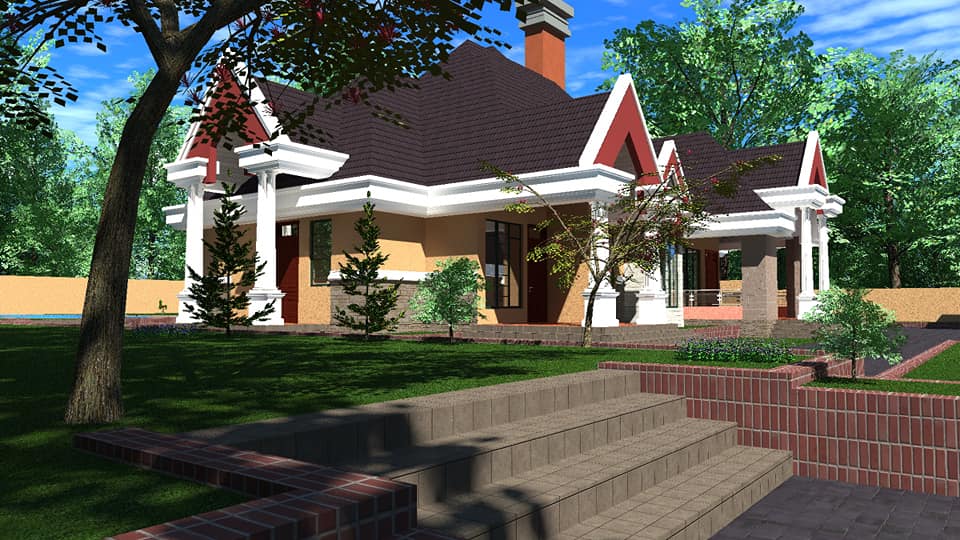
You can commission a custom design or start from a ready-made plan and adapt it to your plot. A ready plan saves time at the concept stage. For example, our 4-bedroom bungalow house design suits a typical family plot, and a modern 3-bedroom bungalow plan with a DSQ works well if you want a staff quarter or a small rental unit at the back.
3. Get structural drawings and a Bill of Quantities
The architectural drawings show what the house looks like. The structural drawings show how it stands up, which matters on Kisumu’s clay soils. The Bill of Quantities (BQ) lists every material and its quantity, so you can compare contractor quotes line by line instead of guessing.
4. Get county approval
Building plans must be approved before construction starts. In Kisumu, development control falls under the county’s Department of Lands, Physical Planning, Housing and Urban Development, which has also issued public notices asking developers to follow zoning regulations. Expect the county to ask for the stamped architectural and structural drawings, proof of ownership and the applicable fees. Larger projects may also need an environmental assessment. For the general sequence, see our step-by-step building approval process in Kenya.
5. Choose a contractor and sign a clear contract
The National Construction Authority was set up under the NCA Act of 2011 to oversee the construction industry, so ask every contractor for their NCA registration and check it. Then agree a written contract with a price based on the BQ, a payment schedule tied to completed stages, and a programme with dates.
6. Build in clear stages
A typical single-storey house moves through these stages: site clearing and setting out, foundation, slab, walling up to ring beam, roofing, plastering and services (plumbing and wiring), then finishes and external works. Pay against each completed stage, not in advance of it.
How long does it take?
| Phase | What happens | Typical duration |
|---|---|---|
| Design and BQ | Concept, architectural and structural drawings, BQ | 3–6 weeks |
| Approvals | County submission, comments, approval | Varies by county workload; plan for several weeks |
| Construction (bungalow) | Foundation to finishes | About 4–8 months with steady funding |
| Construction (maisonette) | Foundation to finishes, plus first-floor slab | About 6–12 months with steady funding |
Kisumu’s long rains usually fall between March and May. Try to finish the foundation and slab before heavy rain, or budget for pumping out trenches and protecting materials on site.
How to choose a building contractor in Kisumu
Use this checklist when you interview builders:
- Are you registered with the NCA, and in which category?
- Can I visit two houses you have completed and one that is under construction?
- Will you price from my BQ, and will you show me the rates for each item?
- Who will be on site every day, and who supervises the fundis?
- How will you send me progress updates: photos, videos, site reports?
- What is your payment schedule, and how much retention will I hold until handover?
- Who handles approvals, and are the approval fees in your price?
Many owners find it easier to hire one firm for design, approvals and construction. We explain how that works, and why it reduces disputes between architect and builder, in our guide to design and build in Kenya.
Common mistakes when building in Kisumu
- Skipping the soil test on black cotton soil, then seeing cracks in walls within a few years.
- Starting without approval to “save time”, then facing stop orders or problems when selling or borrowing against the house.
- Paying a contractor large advances instead of paying for completed stages.
- Buying cheap ballast and sand without checking quality, which weakens concrete.
- No drainage plan on flat, low-lying plots, leading to standing water around the foundation during the rains.
- Changing the design mid-way, which is the fastest way to blow a budget.
Building in Kisumu from Nairobi or abroad
If you live in Nairobi or outside Kenya, insist on a BQ-based price, milestone payments, weekly photo and video updates and an independent stage inspection before each payment. These simple controls protect your money far better than relying on a relative to “keep an eye” on the site.
Questions to settle before you start
- What is my total budget, including approvals, professional fees and a 10% contingency?
- Do I build all at once or in phases, and which stage can I fully fund now?
- Bungalow or maisonette: which suits my plot size and my family?
- Do I want a DSQ or rental units for extra income?
- Who will manage the project day to day?
Related guides
- Design and build in Kenya: one contractor from plan to handover
- Cost of building an apartment in Kisumu
- Property valuation in Kisumu
Want the real cost of YOUR house in Kisumu?
Send us your plot location, the number of bedrooms and your budget on WhatsApp. Our team in Kisumu will reply with a free indicative cost estimate and the next steps for design, approvals and construction.
Or call 0789 217 685 / 0724 481 087.